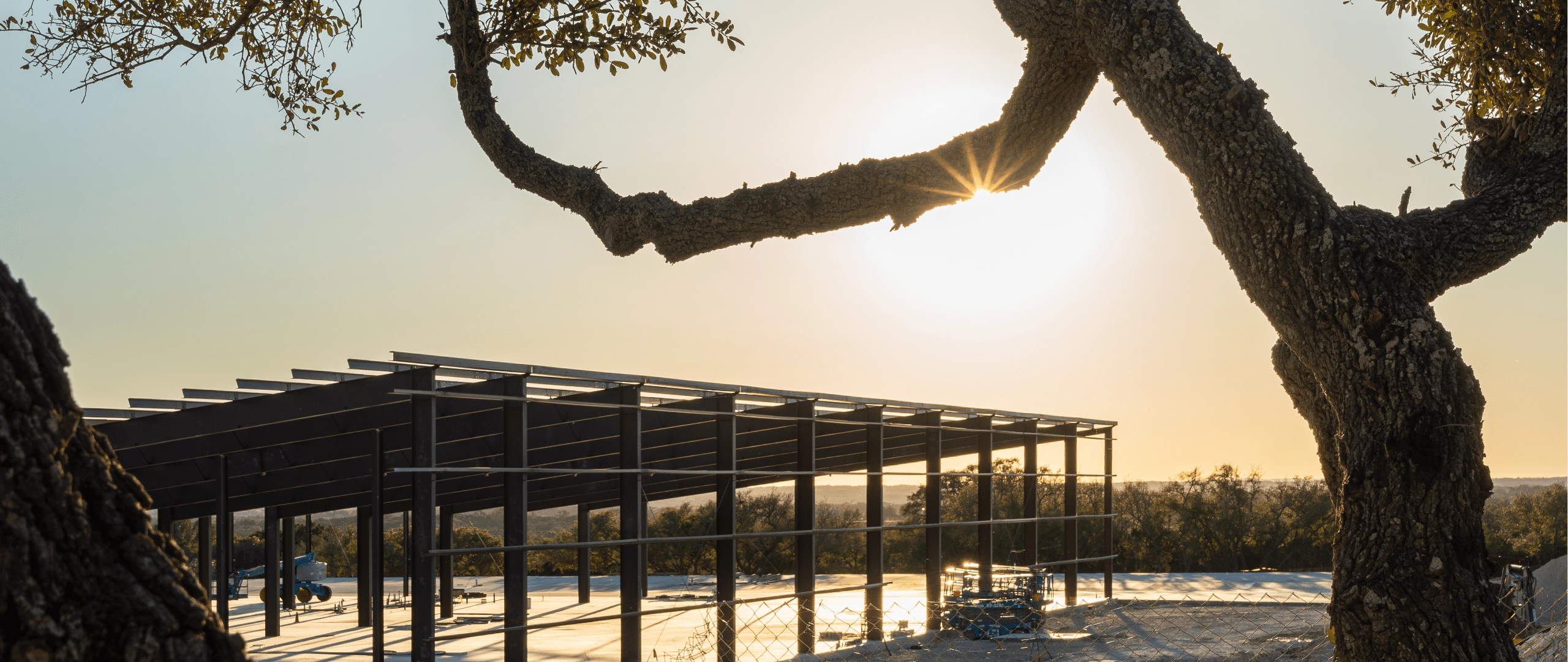
Construction on Delta Millworks’ new headquarters and manufacturing campus in Wimberley, Texas is now approximately halfway complete, with the primary structure and site infrastructure well underway.
Designed by Pollen Architecture & Design with environmental consultation by Blackland Collaborative, the 88,000-square-foot facility is organized across a 33-acre site along Ranch Road 12. The project has been planned to limit disturbance, with less than 20 percent of the site designated as impervious cover. Construction has largely followed the existing topography, retaining the majority of mature trees—including a number of large live oaks—and preserving native prairie at the front of the property.
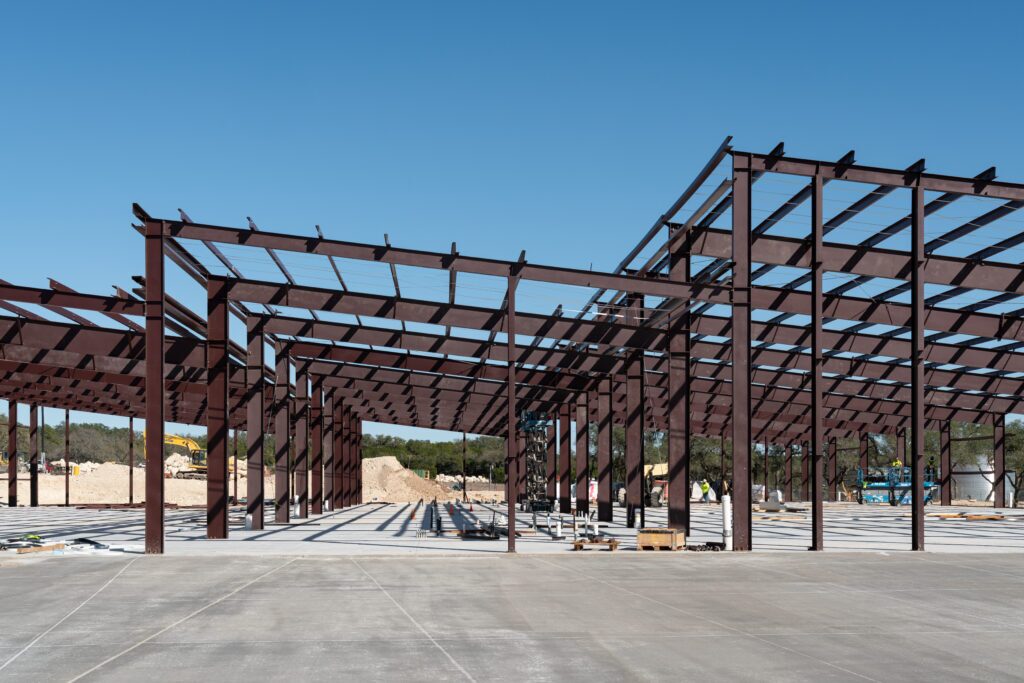
The building framework is now in place, making the organization of the facility legible. Two mill halls are arranged around a central spine that will house research, development, and testing functions. The sawtooth roof—an evolution of the system used at Delta’s East Austin facility—will provide consistent north-facing daylight to the production floor. A mezzanine level for visitor circulation is also in development, along with a series of covered exterior areas intended for break and transition spaces.
At the front of the site, the showroom and office building is beginning to take shape, maintaining a lower profile along the streetfront while the primary manufacturing volume remains set back.
In parallel with the vertical construction, site systems are being installed to address the environmental conditions specific to the Texas Hill Country. The project sits within a karst limestone watershed, where water infiltration and aquifer recharge are directly impacted by development patterns. In response, the campus has been designed to reduce runoff and support on-site water management.
Three cisterns are currently being constructed across the property—two positioned near the front of the site for irrigation use, and a third at the rear, designed for future potable water integration. These are tied to a broader rainwater harvesting system with a total capacity of more than 180,000 gallons, intended to support irrigation, fire suppression, and stormwater control. The system is designed to slow and redistribute water across the site, working in conjunction with the preserved landscape areas.
As the project moves into its next phase, Delta 2.0 is not only taking physical shape but beginning to demonstrate the full scope of its ambition—bringing together expanded manufacturing capacity, a more integrated workflow, and a site strategy that responds directly to the realities of building in the Texas Hill Country.